The German-trained designer Will Burtin, (from Cologne), reached New York with his wife Hilde as refugees in 1938. For his first commission in the United States, Burtin created the flexOprop identity mark that year for Dr. Max M. Munk’s company, Munk Aeronautical Laboratory. Max Munk and Burtin’s wife, Hilde née Munk, were cousins. Years later, Burtin ran the flexOprop logo he designed for Max in ‘Seven Designers look at Trademark Design’ (E. Jacobson, ed., 1952).
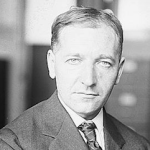
Max Munk, (from Hamburg), trained as an aeronautical engineer in Germany. With doctorates in both physics and mathematics, he worked on airships with Graf Zeppelin. After World War I, President Woodrow Wilson signed an order allowing the U.S. Army to import Max and his skills to the United States. Max, in return, requested that his twin sister, Thekla, and their mother, should come with him. In the U.S., the Burtins’ ‘Uncle Max’ “achieved lasting fame by proposing, conceiving, developing, and placing into operation the Langley Variable Density [Wind] Tunnel.” [NASA]
This was the most significant achievement for the early NACA, [National Advisory Committee for Aeronautics], where Munk held senior positions and wrote over 40 scholarly articles. “The Langley Memorial Aeronautical Laboratory [placed NACA] at the forefront of the world’s aeronautical leaders.” That is how the modern NASA describes Max’s accomplishment; NACA became NASA on October 1st, 1958. For its historical interest, NASA displays one of Munk’s first papers, an analysis of the crashed, nine-winged Caproni Seaplane, (NACA Technical Note 57, Jul 1921, pp. 16). How Munk would have loved watching NASA’s rovers tour Mars!
Meanwhile, Will Burtin became a starred designer to mid-century America. Somewhere in mid-Atlantic, two passengers on the SS Rotterdam, Hilde and Will, had agreed never again to speak German to each other; instead, they stammered in broken English; Hilde became Hilda. Within months of stepping off the Rotterdam in New York, Burtin secured good contacts and won a major contract from the Federal Works Agency. Burtin, a very recent immigrant, was assigned to design the Agency’s 1939 World’s Fair exhibit. His practice, and his English, rapidly improved. Post World War II, while planning illustrations for an article in Fortune called ‘The Physics of the Bomb’ (May 1946), Burtin interviewed Albert Einstein speaking only English; Einstein replied in German. Family and friends have had a good chuckle at that ever since. / Robert Fripp