

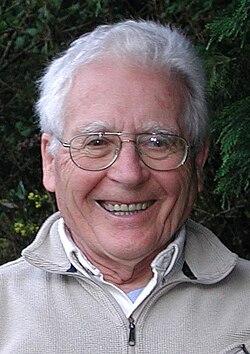
By Robert Fripp.
First published in THE DORSET YEARBOOK, 2023.
This is not an obituary. It is a note of thanks for his scientific discoveries, and the paths that James E. Lovelock urged humans to follow, especially the concept of Gaia, often called the Gaia hypothesis. Lovelock’s research on Gaia attempts to show that Earth’s biosphere is a living, organic thing. He lived in Wiltshire, Devon, then Dorset in his life’s final decade. If the name of any scientist in Lovelock’s generation survives for centuries, it may be his. His work drew attention from an international public and fellow scientists en masse to the physiological suffering that humanity has imposed on a mishandled organism; namely, our place of life and refuge: planet Earth.
In the late 1980s, my wife, Carol Burtin Fripp, invited James Lovelock to give a full account of his Gaia hypothesis to her Canadian television audience in Toronto. Its author would have the opportunity to explain Gaia, aided by an interviewer, in an uninterrupted 90-minute talk on Carol’s weekly current affairs program, Speaking Out. The program went to air without commercial content on Ontario’s educational channel, TVOntario.
After much trying, Carol managed to reach Lovelock at a conference in Vienna. There with his wife, he was willing to fly to Canada. But, would TVO managers agree to pay two business-class fares to fly a guest and his wife from Vienna to Toronto, then return them to London? Lovelock’s book, Gaia A New Look at Life on Earth, had been published in 1979, ten years earlier; its significance had shaken the thoughts of earth scientists, but Carol had to explain to her network’s managers: who was Lovelock? Further, what was the deep significance of the Gaia hypothesis? Management’s answer to the travel costs came back: ‘Fly them over. Bring them in.’
We met Lovelock at his hotel in Toronto and took him to dinner before the show. We did not meet his wife. He gave an excuse for her and we never met. We learned later that she was seriously ill, but that the couple often travelled together. On such occasions he did his best to care for her en route. He had a medical qualification, as well as others.
James Lovelock — ‘Call me Jim’ — was the co-author of The Gaia hypothesis — which has become the Gaia theory, still named for the Greek goddess of Earth. Gaia suggests that Earth, with its many organic, physical and chemical systems, reacts to conditions as if it were a single organic entity. In short, Earth is a complex, self-regulating organism that sustains conditions favouring life.
In the early 1970s, N.A.S.A. hired a team: chemist and inventor Jim Lovelock, and American biologist Lynn Margulis.[1] Their task was to discover more precisely the conditions on the surface of Mars, and suggest possibilities for a human presence. Their discoveries amounted to a parcel of findings that reached way beyond the surface of Mars. It supplied Lovelock with much of the research he needed to work up his hypothesis for Gaia.[2]
In 1979, he took the world by storm with, Gaia: A New Look at Life on Earth. In much of the truly ancient, primal world of humanity, human societies imbued each mountain, rock and tree with one or more spirits; spirits propelled each water course and drove the ever-restless air. Some were benign, others malign. This multitude of earthy, airy and watery spirits comprised a snakes’ nest of seething contradictions. But, in her quiet wholeness, one goddess embodied them all; the ultimate feminine spirit, the Earth-goddess, Gaia. It was Lovelock’s friend and neighbour in Bowerchalke, Wiltshire, the author and Nobel laureate William Golding, who suggested that Lovelock’s theory should take Gaia’s name.
Lovelock’s hypothesis is rigidly, absolutely based in hard science, conventional facts and figures. It contains not a whiff of ancient philosophy — except its name. Lovelock drew from geology, geochemistry, atmospheric chemistry, climatology, physiology and many an aspect of biology. He had used these solid scientific disciplines philosophically; but he could see on planet Earth how they interlocked, interacted and reacted with each other, appropriately, it seemed, for sustaining life. Lovelock showed how each natural force combined with others to form a link in a chain. From Earth’s molten core to its lithosphere, from its oceans to its atmosphere and biosphere, Lovelock proposed that Earth as a whole displays characteristics of a huge, single, self-regulating organism.
Ideas may take years to ferment: Lovelock credited earlier work by ecologist Eugene Odum, philosopher Stephen Zivadin and other ‘geophysiologists’, to use his term for his new science.[2] However, it was not until he collaborated with biologist Lynn Margulis that ‘the skeleton Gaia hypothesis grew flesh and came alive’ for him in 1973. At that point it took flight as a theory of Earth as an organic being.
‘Gaia theory forces a planetary perspective,’ writes Lovelock. ‘It is the health of the planet that matters.’ To that end, he ‘had come to realise that there might be the need for a new profession: that of planetary medicine.’
Predictably, the Gaia hypothesis was lauded by environmentalists and free-spirits from the late ’60s, but scorned by many scientists.
During his struggle to introduce scientific facts, he commented, on 18th July, 2020: ‘I would love to be able to speak to Galileo to understand how he felt. We were both loners who met a lot of opposition. I think Galileo’s problem was largely with the Church rather than people at large. It was so contrary to their dogma that they hated it.’
The challenge that bowled over Gaia and Lovelock was the scientific establishment and its own church of conventional wisdom. His hypothesis went into eclipse for a while. It seemed too unworldly, too wholistic, too New Age. Sceptics abounded …
… But Gaia rebounded. Why? I venture to Canada to explain. Canadians may recall the dramatic recovery of the Ojibway shaman/artist Norval Morrisseau, who had gone through all sorts of treatments without finding a cure for his ills. Cure came only after a shaman beside his hospital bed in Winnipeg changed his name to one that conveyed more power: she renamed him Copper Thunderbird. It was then that Morrisseau recovered from serious illness. He signed his art with that name in Cree syllabics, ᐅᓴᐘᐱᑯᐱᓀᓯ, until he died.
Jim Lovelock did the same for Gaia. He changed its name to Geophysiology. The Independent on Sunday magazine[3] quotes him: ‘By calling [Gaia] geophysiology, I thought [scientists] would be kept happy.’ They were. Suddenly a hypothesis changed its name, which won it promotion to a theory in hard science, and it became a serious study for enquiry. Dr. Richard Holland of Harvard University, formerly a prominent critic of Gaia, became a founding member of the Geophysiological Society. The name change won Lovelock’s patient, our Earth, the long-overdue attention of appropriate doctors — the community of earth-sciences researchers. Many are they who are now driving science towards the Green movement and, as needs must be, will take it far beyond.
Other factors helped bring about a positive change of attitude. Physics had long assumed that we live in a universe grounded in chaos and scattered by entropy — the gloomy promise of the Second Law of Thermodynamics. But recent research seems to support A.N. Whitehead’s conclusion that atomic and molecular interactions show orderliness at basic levels. Something — Nature, if you will — imposes order. Molecular construction, destruction and change seems to be explicitly designed.
That raised the thought: if order imposes itself on the microcosmic world of atoms, is it also at work in the macrocosm?
Driven by that question, science is exploring Gaia — Excuse me! Geophysiology — this time from a more holistic point of view. Gaia’s ordering is fully scalable: from the scale of atoms to the planet’s atmospheric envelope. To find an example, let’s pull a single straw from a haystack of facts: Emiliana huxleyii is a marine organism, a single-celled green plant, blooms of which cover vast areas of the deep oceans. ‘Emily’ removes carbon dioxide from the air, replacing this heat-trapping gas with oxygen. Moreover, Emily and her kind generate vast amounts of dimethyl sulfide gas that rises in the atmosphere to form an aerosol of sulfuric acid droplets. These droplets form the nucleii around which water vapour condenses, forming clouds. Since oceans cover two thirds of the planet, the resulting cloud cover contributes powerfully to reflecting solar radiation, thereby cooling our atmosphere. Lovelock and others suggested that marine microorganisms generate enough dimethyl sulfide to cool our gaseous atmosphere to the same degree that carbon dioxide warms it.[4] From life, to gas, to heat-reflecting liquid, to continued conditions protecting life that screen us from above. Animate, inanimate; yin and yang. All critical parts of the wheel. Tiny components directing the whole. Gaia as self-regulator. Gaia as medicine and healer.
Scientists now realise that the chemical elements making up our bodies were once forged in the nuclear fusion-fires of long-dead stars. Musing along those lines, Jesuit astronomer William Stoeger of the Vatican Observatory Research Group comments that modern cosmology shows how humans are woven into the skein of the cosmic network. We belong; as do all other beings. As, for example, when the healing powers of microorganisms help regulate the temperature of the planet’s atmosphere to facilitate life-giving rainfall. Here we have Gaia as shaman.
Discovering the intricate perfections of Earth’s abiding systems, reminds me of Pa’Ris’Ha, a shaman of the Eastern Cherokee, who told me: ‘Our prophecies state that man will never annihilate himself, that the great intelligence that created him will always arouse again the nature of God in him. … That message is coming directly from the heart of the Mother, from the sky, from the sun.’ That sounds optimistic; more so than Lovelock, who, in his final decade seemed pessimistic about humanity’s ability to mend its ways on a heating, hurting planet.
This bit of story needs a name: ‘Prometheus unbound,’ perhaps, which was probably the name of the third, lost play in Æschylus’ trilogy. The unknown history of our species on this planet stretches out ahead. It is for us to write that missing part. Soon, the human ape may re-discover something its shamans have never forgotten: we see many manifestations, but only one Ark. We and our partners on this hurtling ball of rock are locked in an endless intercourse of spirit and spirits—a common sacred heritage, if you prefer. Discovering that, we may be able to re-integrate ourselves into the greater scheme of things—in the process discovering what we are.
[1] Lynn Margulis, Gaia’s co-creator, also regarded as a scientific rebel, is known independently for her work on the evolution of cells with nuclei.
[2] Vladimir Vernadsky published The Biosphere in 1926. In some ways it runs parallel to Gaia, but was only translated from Russian as recently as 1998. Lynn Margulis wrote its English preface, and a team of 14 translated it.
[3] 4th August, 1996, p.40, Healing the Rift, by Oliver Tickell.
[4] The contribution of phytoplankton does not end there. Terrestrial plants need traces of sulphur which most soils lack. Earth’s rich flora may owe much to ocean-derived sulphur falling in rain.